A Slap in the Facebook
Wednesday, April 8, 2009
Dear Miss Manners:
With the use of online chatting and social networks like Facebook, some people feel comfortable sharing their current state of mind on away messages or status messages. For instance, a friend of mine had the following message up: "The misery just doesn't end. Yet another bad week." Another friend had this message up: "Good to know I've found the person I might be ready to settle down with."
When I asked the first friend why she was having a bad week, she said that "things" have been happening lately. I tried to get a little more information from her, but realized she wasn't really providing me with any, so I backed off and just told her I hoped things would get better.
She later mentioned in the online conversation that I was not a good "conversationalist." Am I supposed to beg people for information from now on?
As for my friend who thought announcing a soon-to-be fiancee was an appropriate thing to do on Facebook, I tried asking him about his status as well. His response was that he would prefer to keep things on the "down low" for now and that his status message was not an invitation for people to pry.
Am I going crazy here, or are people really sending mixed signals? It seems to me that some people purposely try to get you to ask them questions, but when you do, they brush you off or act like YOU are the one prying into their business, even when they opened the door in the first place. Why is it so hard to be a good friend these days? Help!
Miss Manners says:
Your friends are turning into virtual friends. They want to advertise their every move and feeling to a presumably rapt and admiring audience but do not want to participate in the give-and-take of actual friendship.
The model for this, as Miss Manners is not the first to observe, is the celebrity. They "do" publicity through trusted chroniclers -- in this case themselves -- but are huffy about their "privacy" when they manage to attract someone's interest, which must be seldom enough.
So to continue your admirable concern for friends, Miss Manners is afraid you must note whether their confidences are being made to you as a friend or the wide world of virtual so-called friends who are not expected to show interest. Or you could make new friends who value real friendship.
Showing posts with label Facebook. Show all posts
Showing posts with label Facebook. Show all posts
Wednesday, April 08, 2009


Sunday, January 20, 2008
Facebook = Granfalloon
Earlier last year, Emily Yoffe wrote a humorous column for Slate titled Fiftysomething, Facebooking, and Fabulous! with the sub-heading, "Last week I had zero friends on Facebook. Now I have 775."
Although it has some "old-fart-discovers-new-tech" content, it also has many witty observations and anecdotes about Facebook, and about friendships.
I learned a new word from the column - granfalloon, which Yoffe used in reference to having too many Facebook friends and being in Facebook groups/networks. Other writers have also used the word to describe the sometimes-superfluous networks formed by users on social networking sites like MySpace and LinkedIn.
From Wikipedia:
A granfalloon is defined as an imagined community, that is, a group of people who outwardly choose or claim to have a shared identity or purpose, but whose mutual association is actually meaningless. The most common granfalloons are associations and societies based on a shared but ultimately fabricated premise.

What a wonderful word, and could there be a more fitting description of Facebook?
It is interesting to note that granfalloon isn't even a new word. It was coined in 1963 by Kurt Vonnegut (RIP), in his novel Cat's Cradle.
Full disclosure: I've recently updated the Wikipedia entry on granfalloon; I added the part about social networking sites.
Although it has some "old-fart-discovers-new-tech" content, it also has many witty observations and anecdotes about Facebook, and about friendships.
I learned a new word from the column - granfalloon, which Yoffe used in reference to having too many Facebook friends and being in Facebook groups/networks. Other writers have also used the word to describe the sometimes-superfluous networks formed by users on social networking sites like MySpace and LinkedIn.
From Wikipedia:
A granfalloon is defined as an imagined community, that is, a group of people who outwardly choose or claim to have a shared identity or purpose, but whose mutual association is actually meaningless. The most common granfalloons are associations and societies based on a shared but ultimately fabricated premise.
What a wonderful word, and could there be a more fitting description of Facebook?
It is interesting to note that granfalloon isn't even a new word. It was coined in 1963 by Kurt Vonnegut (RIP), in his novel Cat's Cradle.
Full disclosure: I've recently updated the Wikipedia entry on granfalloon; I added the part about social networking sites.
Monday, December 10, 2007
Facebook becoming a real word?
Merriam-Webster (MW) recently concluded its annual Word of the Year poll, and the results are pending.
To my surprise, "facebook" is on this year's list. You might recall that MW ran a similar poll last year, and the word "truthiness" won by a large margin, beating out even "google".
The fellas over at Mountain View got the last laugh though - "google" was inducted as a verb in both the Oxford English Dictionary (OED) and the Merriam-Webster Dictionary last year.
News.com: Google joins Xerox as a verb
You can view the MW definition here, and the Dictionary.com listing here.
Facebook has some ways to go before it becomes a real word. For now, it has only made it as far as MW's open dictionary, which defines facebook and facebooking. I'm sure Mark Zuckerberg ordered all his employees to vote up "facebook" in the MW poll. At this point though, I feel that the word is mainly synonymous with "time-wasting" or "goofing off".

It should be noted that "truthiness", despite being 2006 word of the year, has not been included in the MW dictionary. It is still listed in the open dictionary. Unsurprisingly though, truthiness does have its own Wikipedia entry.
Just what is this open dictionary? MW says it contains words submitted by "other members of the Merriam-Webster Online community", which, as far as I can tell, means "any damn fool on the Net". If that is the case, then the open dictionary doesn't seem to be any different from the Urban Dictionary.
So what does it take for a word to be added to "real" dictionaries?
Graeme Diamond, Senior Assistant Editor at Oxford University Press provides some insight. He is responsible for researching, drafting, and editing dictionary entries for new English words and meanings.
New Words: How do they get into the Oxford English Dictionary?
MW has a FAQ covering the same topic.
How does a word get into a Merriam-Webster dictionary?
In a related issue, this article in the NYT seems to dismiss WOTY (word of the year) polls as gimmicky, publicity-seeking stunts by dictionary publishers.
To my surprise, "facebook" is on this year's list. You might recall that MW ran a similar poll last year, and the word "truthiness" won by a large margin, beating out even "google".
The fellas over at Mountain View got the last laugh though - "google" was inducted as a verb in both the Oxford English Dictionary (OED) and the Merriam-Webster Dictionary last year.
News.com: Google joins Xerox as a verb
You can view the MW definition here, and the Dictionary.com listing here.
Facebook has some ways to go before it becomes a real word. For now, it has only made it as far as MW's open dictionary, which defines facebook and facebooking. I'm sure Mark Zuckerberg ordered all his employees to vote up "facebook" in the MW poll. At this point though, I feel that the word is mainly synonymous with "time-wasting" or "goofing off".
It should be noted that "truthiness", despite being 2006 word of the year, has not been included in the MW dictionary. It is still listed in the open dictionary. Unsurprisingly though, truthiness does have its own Wikipedia entry.
Just what is this open dictionary? MW says it contains words submitted by "other members of the Merriam-Webster Online community", which, as far as I can tell, means "any damn fool on the Net". If that is the case, then the open dictionary doesn't seem to be any different from the Urban Dictionary.
So what does it take for a word to be added to "real" dictionaries?
Graeme Diamond, Senior Assistant Editor at Oxford University Press provides some insight. He is responsible for researching, drafting, and editing dictionary entries for new English words and meanings.
New Words: How do they get into the Oxford English Dictionary?
MW has a FAQ covering the same topic.
How does a word get into a Merriam-Webster dictionary?
In a related issue, this article in the NYT seems to dismiss WOTY (word of the year) polls as gimmicky, publicity-seeking stunts by dictionary publishers.
Saturday, December 01, 2007
Blocking stupid Zombies, Vampires, et al apps
Boy, is there anything more annoying on Facebook than those idiotic Zombies, Vampires, et al apps?
I didn't install any of them, of course, but somehow, other people's actions were showing up on my News Feed.
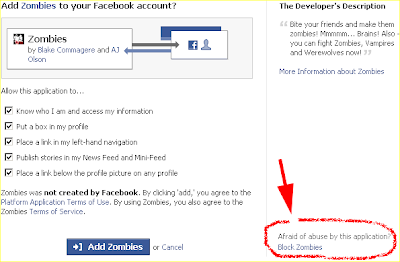
Turns out you can block all updates from these apps by surfing to their main page, and clicking on the Block app link. It's located at the lower right corner, below the "Afraid of abuse by this application?" question:
http://apps.facebook.com/zombies/
http://apps.facebook.com/vampires/
http://apps.facebook.com/werewolves/
http://apps.facebook.com/slayers/
If you had previously blocked an app, Facebook will inform you. This step will also work for other abusive and spammy apps.
I didn't install any of them, of course, but somehow, other people's actions were showing up on my News Feed.
Turns out you can block all updates from these apps by surfing to their main page, and clicking on the Block app link. It's located at the lower right corner, below the "Afraid of abuse by this application?" question:
http://apps.facebook.com/z
http://apps.facebook.com/v
http://apps.facebook.com/w
http://apps.facebook.com/s
If you had previously blocked an app, Facebook will inform you. This step will also work for other abusive and spammy apps.

Subscribe to:
Posts (Atom)